User Guide
The RADIUSS Shared CI project contains an automated CI infrastructure based on GitLab that we intend be sufficiently flexible and general to be adopted and shared by RADIUSS projects. The infrastructure uses Spack to setup project dependencies and generate build configuration files. This allows projects to easily share the full context of their builds. The project is then built and tested as usual and most of the CI infrastructure is shared to avoid duplication and ease maintenance.
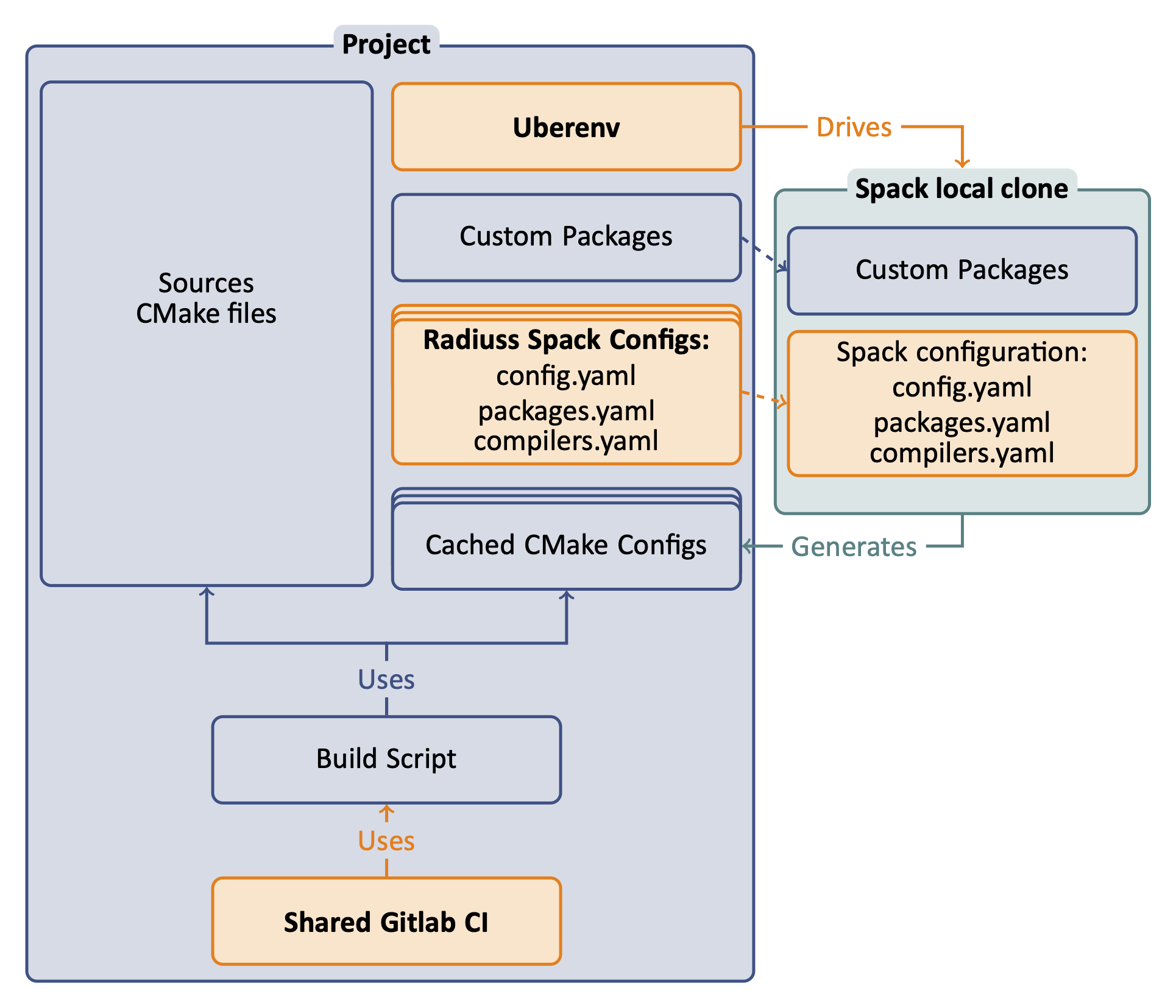
The figure illustrates the various software packages involved (orange boxes) and their relationships to a project that uses them.
Typically, a project has two Git submodules: Uberenv and RADIUSS Spack Configs. Uberenv contains a Python script that helps automate building third-party dependencies for a project. It drives Spack in Unix-based and macOS environments and Vcpkg on Windows. RADIUSS Spack Configs contains a set of compiler and package configurations that projects shared to construct uniform build configurations.
Shared GitLab CI is this RADIUSS Shared CI project, which is hosted on GitHub and is mirrored on the Livermore Computing (LC) CZ GitLab instance. A project points to the GitLab mirror to access RADIUSS Shared CI configurations.
RADIUSS Shared CI design revolves around three steps a project must follow to adopt the shared CI methodology. These are described in the following sections.
We also provide “How To” sections to perform various usage tasks.
Warning
Due to its GitLab CI sharing goal, radiuss-shared-ci is meant to live on LC GitLab instance. The main repo, hosted on GitHub for accessibility and visibility, is mirrored on LC GitLab. To include files from radiuss-shared-ci, we recommend pointing to the mirror repo on GitLab rather than the GitHub one. We only document that option.