Setup the CI using the shared template
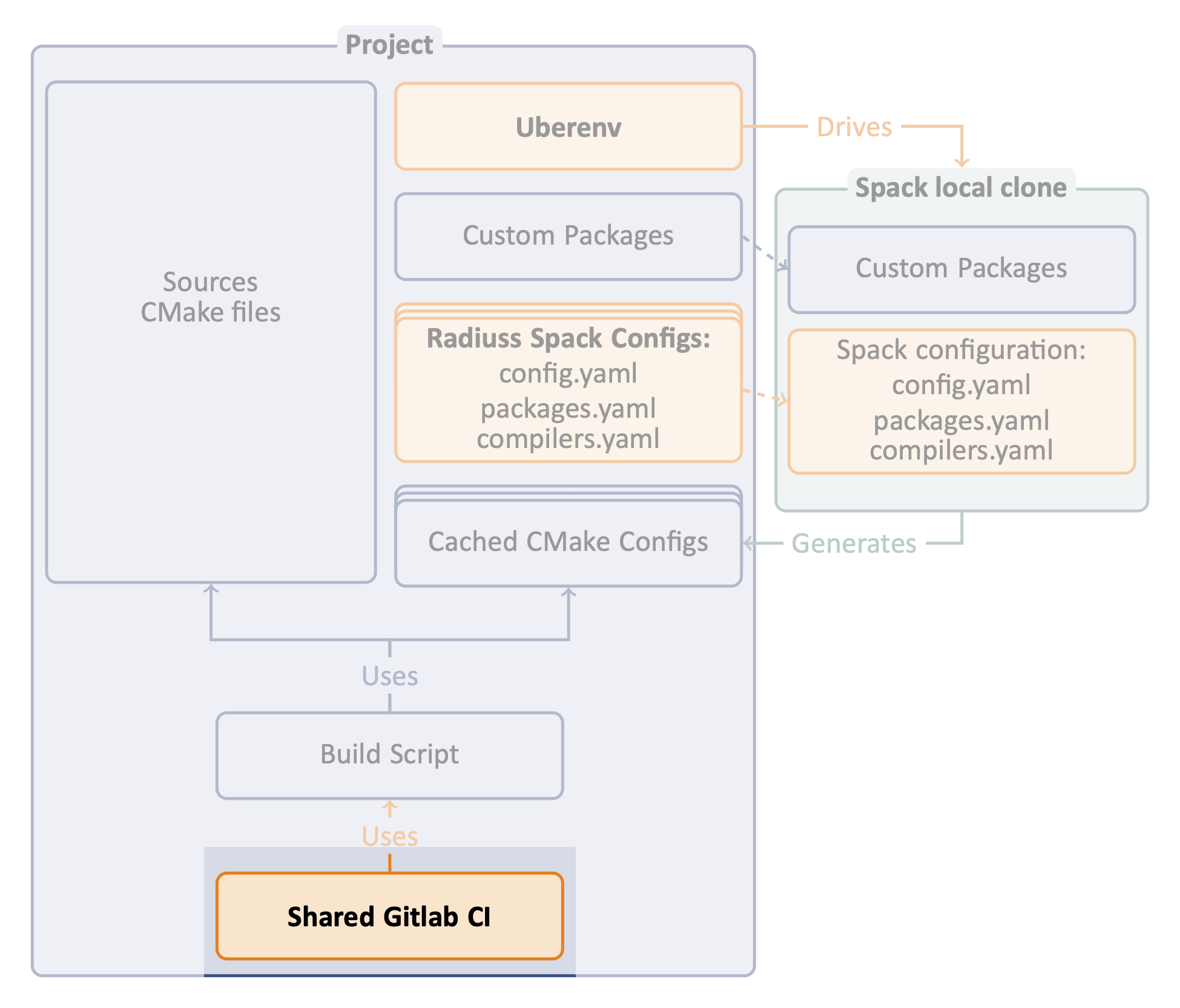
The third step in adopting RADIUSS Shared CI infrastructure is to setup the CI.
Once you have put in the effort to implement the first two steps, you should be able to benefit from the shared CI infrastructure. In more complex scenarios, you will always be able to use the template as a starting point for a custom implementation.
By sharing the CI definition, projects share the burden of maintaining it. In addition, with our shared CI, they also share a core set of Spack specs to ensure that they keep running tests with similar configurations.
RADIUSS Shared CI
Initially, the RADIUSS effort developed a mechanism to
`share Spack configuration files`_ across projects. Then, we developed a
process to manage Spack and use it to generate CMake configuration files.
The RADIUSS Shared CI project extends this by developing a CI implementation
that can be shared across projects, which drive it with a build-and-test
script that has the same inputs across projects.
With a centralized CI configuration that is shared by projects, we create an interface between local and shared configuration. we try to keep this interface minimal, while allowing for project-specific customization. Only a handful of modifications are required to get the CI to work for your projects, while files in the customization directory allow for finer tuning and extensibility.
Note
GitLab allows projects to include external files to configure their CI. We rely on this mechanism to share most of the CI configuration among projects.
The short version
### Prerequisites
cd my_project
mkdir -p scripts/gitlab
vim scripts/gitlab/build-and-test
# write CI script

### CI Setup
cd my_project/..
git clone https://github.com/LLNL/radiuss-shared-ci.git
cd my_project
cp ../radiuss-shared-ci/customization/gitlab-ci.yml .gitlab-ci.yml
mkdir -p .gitlab
cp ../radiuss-shared-ci/customization/subscribed-pipelines.yml .gitlab
cp ../radiuss-shared-ci/customization/custom-jobs-and-variables.yml .gitlab
cp ../radiuss-shared-ci/example-extra-jobs/*-extra.yml .gitlab
vim .gitlab/subscription-pipelines.yml
vim .gitlab/custom-jobs-and-variables.yml
# customize CI
vim .gitlab/*-extra.yml
# edit extra jobs

### Non-RADIUSS projects
open https://lc.llnl.gov/gitlab/<group>/<project>/-/settings/ci_cd
# Set CI/CD variable GITHUB_TOKEN to hold token with repo:status
# permissions.
Jump to a corresponding section for details on Customize CI, Edit extra jobs and Writing a script for CI.
The detailed version
Our CI implementation can be divided in four parts:
local build-and-test script
shared files
customization files
extra jobs
Setting up the CI consists of four corresponding steps.
Write CI Script
The first step is to provide a CI script, which you should already have after completing Writing a script for CI at Step 2.
Once you have that script, you are ready to move on to the CI setup.
Core CI implementation
Start by cloning the RADIUSS Shared CI project locally, for example next to the project you intend to add CI to.
cd my_project/..
git clone https://github.com/LLNL/radiuss-shared-ci.git
cd my_project
By default, GitLab expects a .gitlab-ci.yml file to interpret the CI setup.
We provide one in customization/gitlab-ci.yml that projects can copy-paste.
Make sure to place the file in the top-level directory of your project, and
that it has a dot (.) at the beginning of the name.
cp ../radiuss-shared-ci/customization/gitlab-ci.yml .gitlab-ci.yml
In the .gitlab-ci.yml file, there are some variables you need to adapt to
your project. They are described in the following table:
Parameter
Description
LLNL_SERVICE_USERProject specific Service Account used in CI
CUSTOM_CI_BUILD_DIRWhere to locate build directories (prevent overquota)
GIT_SUBMODULES_STRATEGYControls strategy for the clone performed by GitLab. Consider
recursiveif you have submodules, otherwise comment it.
BUILD_ROOTLocation (path) where the projects should be built. We provide a sensible default.
Note
If a variable is blank in the template file, then it does not require a value. If a variable has a value there, it does require one.
Warning
We strongly recommend that you set your CI to use a service account.
Your CI is now set up to include remote files from the GitLab mirror of the radiuss-shared-ci project.
We now have to complete the interface with the shared CI configuration.
In particular, the .gitlab-ci.yml file requires some files to be present
in your Git repository. These are described in the next few sections.
Customize CI
We provide templates for the required customization files. You need to have a
.gitlab subdirectory in the top-level directory of your Git repo. Then,
you can copy the template files to that directory in your repo.
mkdir -p .gitlab
cp ../radiuss-shared-ci/customization/subscribed-pipelines.yml .gitlab
cp ../radiuss-shared-ci/customization/custom-jobs-and-variables.yml .gitlab
We will now browse the files to see what changes they may require to suit your needs.
The .gitlab/subscribed-pipelines.yml file
In this file, you select the machines you want to run tests on. Comment out the jobs (sections) for machines you don’t want, or don’t have access to.
Note
To add a new machine, please refer to Add a new machine.
The .gitlab/custom-jobs-and-variables.yml file
Here is a table that describes each variable present in the file. More details can be found in the file itself.
Parameter
Description
ALLOC_NAMEName of the shared allocation. Should be unique, our default should be fine.
<MACHINE>_BUILD_AND_TEST_SHARED_ALLOCParameters for the shared allocation. You may extend the resource and time.
<MACHINE>_BUILD_AND_TEST_JOB_ALLOCParameters for the job allocation. You may extend the resource and time within the scope of the shared allocation.
PROJECT_<MACHINE>_VARIANTSGlobal variants to be added to all the shared specs.
PROJECT_<MACHINE>_DEPSGlobal dependencies to be added to all the shared specs.
Note
If a variable is blank in the template file, then it does not require a value. If a variable has a value there, it does require one.
You may add configurations to the .custom_build_and_test job that will then
be included in all you CI jobs. This can be used to export jUnit test reports,
for example. Changes to that section are not mandatory.
Edit extra jobs
We provide templates for the extra jobs files. Typically, these files are
included in your project’s .gitlab subdirectory and named
<platform>-build-and-test-extra.yml, where platform is the associated
machine name. Those files are required as soon as the associated machine has
been activated in the .gitlab/subscribed-pipelines file.
If no extra jobs are needed, for example if the shared jobs automatically included are sufficient, then you should add the extra jobs files as-is, with a simple variable definition to prevent it from being empty.
If you need to define extra jobs that are specific to your project, then you may remove the variable definition, uncomment the template job and complete it with the required information:
A unique job name that will appear in CI.
A Spack spec used by
build-and-testto know what to build.
Warning
GitLab supports long and complex job names. Make sure to pick names that are sufficiently unique so that your extra jobs do not override a shared job.
Note
PROJECT_<MACHINE>_VARIANTS/DEPS apply to all the shared specs. If you
want to build a spec without them, you need to define an extra job, even if
this is a shared spec: in that case you can give the extra jobs the exact
same name as the shared one so that the latter will be overridden.
Non-RADIUSS Projects
RADIUSS Shared CI features a customized status report mechanism that reports to to GitHub the CI status of each sub-pipeline (one per machine).
This feature requires the creation of a GitHub token with repo:status
permissions, and registering it as a CI/CD variable named GITHUB_TOKEN in
the project (or the group) on GitLab.
Visit https://lc.llnl.gov/gitlab/<group>/<project>/-/settings/ci_cd to
create the variable once the token has been generated on GitHub.